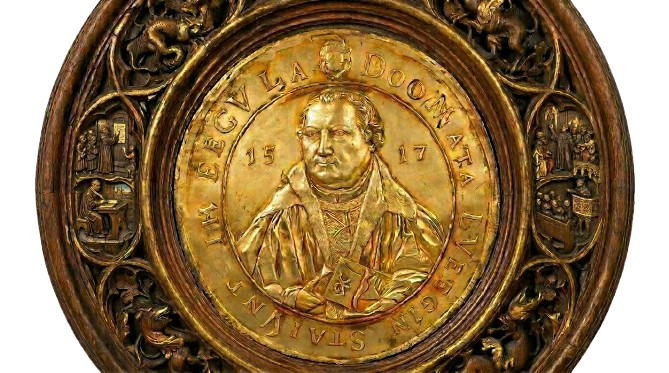

the IARCM collection
The IARCM Collection stands as one of the most comprehensive collections for students of Reformation numismatics and fine art. These collection pieces are not simply rare collectibles; they are primary witnesses to how Lutheran confessional identity, memory, politics, and devotion were understood and expressed over 16 generations. Explore and discover this incredible world of Lutheran faith and life.
collection highlights
500 years of Reformation memory in objects.
Museum-quality collecting and interpretation.
Publications, exhibits, and specialist guidance.
Connections to international scholarship and medal art.


[DNH 486] Cast whitemetal Jan Hus commemorative medal, Magdeburg, [ND] 1530
Physical specifications:
Diameter: 41.21 mm - 41.57 mm
Weight: 23.01 g
Thickness: 3.42 mm
Die axis: medal orientation
Additional physical notes: Holed for suspension.
Provenance:
Acquired on February 21, 2008, from numismatic researcher and cataloger Lutz Ruffert.
References:
See Juncker, Das Guldene (1706), 41, 522–526, who mention this variant spelling, but does not show any billowing smoke in any accompanying illustration; Opitz 1164–1177; Arnold and Hasse, "Luther und Huß: Schwan und Gans," in Zeichen der Identität (2024), 123–144.
Description:
This is a cast whitemetal medal produced at the time Albrecht von Brandenburg, Archbishop-Elector of Magdeburg (1513–1545) ruled Magdeburg. Thie pieces is attributed to medalist Hieronymus Magdeburg +1540, and dated [ND] 1530. It falls within the Silver Age of Reformation numismatics and commemorates the 200th anniversary of the martyrdom of Bohemian Jan Hus at the Council of Constance on July 6, 1415; it is commonly referred to as the Hußtaler.
The obverse shows a right-facing portrait of Jan Hus (1369–1415) in Talar with doctor's cap. The obverse inscription reads IOÃ / HVS // SANCTAM • CATOLICAM + CREDO • VNAM • ESSE • ECCLESIAM [IOHANNES HUS SANCTAM CATOLICAM CREDO VNAM ESSE ECCLESIAM] (John Hus // I believe in one holy catholic church). The reverse shows the full figure of Jan Hus bound and fitted with a heretic hat, being burned at the stake with accompanying billows of smoke. The double encircling inscription reads IO • HVS • CONDEMNATVR • CRISTO • NATO • 1415 // ANNO • A • CENTVM • REVOLVTIS • ANNIS • DEO • RESPVNDEBITIS • ET • MIHI [IO HUS CONDEMNATVR CRISTO NATO 1415 // ANNO A CENTVM REVOLVTIS ANNIS DEO RESPVNDEBITIS ET MIHI] (Condemned Jan Hus, born in Christ in [the year] 1415 // After one hundred years have passed, you will answer to God and to me).
This commemorative medal of Hus is often referred to as the “Hußtaler" and communicates the strong identification the Lutheran Reformation had with what was seen as a direct precursor to Luther. This is a very rare variant with (a) the “RESPVNDEBITIS” spelling and (b) billows of smoke on the reverse instead of the more common two-line inscription “CON / DEM // NA / TVR." Very sharp detail for a cast medal. In choice, almost uncirculated condition.
[DNH 487] Cast brass Jan Hus commemorative medal, Magdeburg, [ND] 1530 or later casting
Physical specifications:
Diameter: 39.86 mm x 38.60 mm
Weight: 12.77 g
Thickness: 2.21 mm
Die axis: medal orientation
Provenance:
Acquired on February 21, 2008, from numismatic researcher and cataloger Lutz Ruffert.
References:
Juncker Das Guldene (1706), 41, 522–526; Opitz 1164–1177; Arnold and Hasse, "Luther und Huß: Schwan und Gans," in Zeichen der Identität (2024), 123–144.
Description:
This is a cast brass medal produced at the time Albrecht von Brandenburg, Archbishop-Elector of Magdeburg (1513–1545) ruled Magdeburg. Thie pieces is attributed to medalist Hieronymus Magdeburg +1540, and dated [ND] 1530. It falls within the Silver Age of Reformation numismatics and commemorates the 200th anniversary of the martyrdom of Bohemian Jan Hus at the Council of Constance on July 6, 1415; it is commonly referred to as the Hußtaler.
The obverse shows a right-facing portrait of Jan Hus (1369–1415) in Talar with doctor's cap. The obverse inscription reads IOÃ / HVS // SANCTAM • CATOLICAM + CREDO • VNAM • ESSE • ECCLESIAM [IOHANNES HUS SANCTAM CATOLICAM CREDO VNAM ESSE ECCLESIAM] (John Hus: I believe in one holy catholic church). The reverse shows the full figure of Jan Hus bound and fitted with a heretic hat, being burned at the stake. CON / DEM // NA / TVR appears in two lines to the right and left of the figure. The double encircling inscription reads NATO • 1415 • IO • HVS / ANNO • A • CHRISTO // [Hieronymus Magdeburg insignia] • CENTVM • REVOLVTIS • ANNIS • DEO • RESPVNDEBITIS • ET • MIHI. [NATO 1415 IO HVS / ANNO A CHRISTO CENTVM REVOLVTIS ANNIS DEO RESPVNDEBITIS ET MIHI] (Jan Hus, born in Christ in [the year] 1415 // After one hundred years from Christ, you will answer to God and to me).
This commemorative medal of Hus is often referred to as the “Hußtaler" and communicates the strong identification the Lutheran Reformation had with what was seen as a direct precursor to Luther. This is a very rare variant with (a) the “RESPVNDEBITIS” spelling on the reverse. Acceptable detail of medium quality cast, but with distinct HM monogram.


[DNH 607] Cast silver “Sacrifice of Isaac / Sacrifice of Christ” medal, 1539
Physical specifications:
Diameter: 54.30 mm x 54.76 mm
Weight: 43.43 g
Thickness: 5.11 mm
Die axis: medal orientation
Provenance:
This piece sold at Busso Peus A395, Lot 2713 on July 5, 2008; and acquired from the Reformation Coin and Medal Collection of Sculptor Herbert Melher (1949–2010) (Fulda) on August 7, 2008.
References:
Habich II:1, 1974; Schnell 23; Goppel/Plum/Holler 15; Opitz 4353 (erroneous description of reverse: no resurrected Christ standing on empty tomb); see also "Medaillen des 16. Jahrhunderts als Vermittlungsmedien biblischer Inhalte," pages 3236–3237.
Description:
This is a cast silver medal produced in Leipzig under Johann Friedrich der Großmütige (1532–1547) of the Ernestine Electorate of Saxony and dated 1539. It falls within the Silver Age of Reformation numismatics. This is the notable “The Sacrifice of Isaac / The Sacrifice of Christ upon the Cross” medal by renowned Reformation medalist Hans Reinhart the Elder (1510–1581).
The obverse shows Abraham in detailed coat, pants, and boots facing right, with right hand holding a large sword above his head, and left hand upon the head of his son Isaac, bound and kneeling in a prayerful gesture upon the wood of a ready-made altar. A smoking fire-pot and sword sheath lie at his feet. A winged angel reaches out to stop the sword from coming down on Isaac, and the left hand of the angel gestures to the ram caught in the thicket behind Abraham. The inscription reads ABRA: SACRIFI: ISAC [ABRAHAM SACRIFICIUM ISAACI] (Abraham: sacrifice of Isaac). The date and medalist initials are hidden beneath the altar: 15 / 3 / 9 and HR. Foliage on tree and bushes is crafted from small pieces of silver and soldered onto the medal. The reverse shows Christ upon the cross with titular, surrounded by a radiant grouping of clouds. The robbers and their crosses stand to the right and to the left. Mary is comforted by John the Disciple among the Roman solders, one with a lance and one on horseback looking on. The bronze serpent is on the pole in the left background; Adam’s skull lies at the foot of the Cross. Foliage on the robbers’ crosses and Christ’s loincloth is expertly crafted in separate pieces of silver and soldered onto the medal. The inscription reads MIS / ERERE NO / BIS • DOMI / NE [MISERERE NOBIS DOMINE] (Have mercy on us, Lord).
This medal commemorates the Lutheran Reformation’s rediscovery of the strong prophetic link Holy Scripture makes between the sacrifice of Isaac and Christ’s sacrifice upon the Cross. Exemplary, museum-quality condition. This is a fine example of the zenith of Reformation medal design and execution, especially with enhancements of the soldered-on details on both obverse and reverse.
[DNH 487] Cast brass Jan Hus commemorative medal, Magdeburg, [ND] 1530 or later casting
Physical specifications:
Diameter: 39.86 mm x 38.60 mm
Weight: 12.77 g
Thickness: 2.21 mm
Die axis: medal orientation
Provenance:
Acquired on February 21, 2008, from numismatic researcher and cataloger Lutz Ruffert.
References:
Juncker Das Guldene (1706), 41, 522–526; Opitz 1164–1177; Arnold and Hasse, "Luther und Huß: Schwan und Gans," in Zeichen der Identität (2024), 123–144.
Description:
This is a cast brass medal produced at the time Albrecht von Brandenburg, Archbishop-Elector of Magdeburg (1513–1545) ruled Magdeburg. Thie pieces is attributed to medalist Hieronymus Magdeburg +1540, and dated [ND] 1530. It falls within the Silver Age of Reformation numismatics and commemorates the 200th anniversary of the martyrdom of Bohemian Jan Hus at the Council of Constance on July 6, 1415; it is commonly referred to as the Hußtaler.
The obverse shows a right-facing portrait of Jan Hus (1369–1415) in Talar with doctor's cap. The obverse inscription reads IOÃ / HVS // SANCTAM • CATOLICAM + CREDO • VNAM • ESSE • ECCLESIAM [IOHANNES HUS SANCTAM CATOLICAM CREDO VNAM ESSE ECCLESIAM] (John Hus: I believe in one holy catholic church). The reverse shows the full figure of Jan Hus bound and fitted with a heretic hat, being burned at the stake. CON / DEM // NA / TVR appears in two lines to the right and left of the figure. The double encircling inscription reads NATO • 1415 • IO • HVS / ANNO • A • CHRISTO // [Hieronymus Magdeburg insignia] • CENTVM • REVOLVTIS • ANNIS • DEO • RESPVNDEBITIS • ET • MIHI. [NATO 1415 IO HVS / ANNO A CHRISTO CENTVM REVOLVTIS ANNIS DEO RESPVNDEBITIS ET MIHI] (Jan Hus, born in Christ in [the year] 1415 // After one hundred years from Christ, you will answer to God and to me).
This commemorative medal of Hus is often referred to as the “Hußtaler" and communicates the strong identification the Lutheran Reformation had with what was seen as a direct precursor to Luther. This is a very rare variant with (a) the “RESPVNDEBITIS” spelling on the reverse. Acceptable detail of medium quality cast, but with distinct HM monogram.


[DNH 607] Cast silver “Sacrifice of Isaac / Sacrifice of Christ” medal, 1539
Physical specifications:
Diameter: 54.30 mm x 54.76 mm
Weight: 43.43 g
Thickness: 5.11 mm
Die axis: medal orientation
Provenance:
This piece sold at Busso Peus A395, Lot 2713 on July 5, 2008; and acquired from the Reformation Coin and Medal Collection of Sculptor Herbert Melher (1949–2010) (Fulda) on August 7, 2008.
References:
Habich II:1, 1974; Schnell 23; Goppel/Plum/Holler 15; Opitz 4353 (erroneous description of reverse: no resurrected Christ standing on empty tomb); see also "Medaillen des 16. Jahrhunderts als Vermittlungsmedien biblischer Inhalte," pages 3236–3237.
Description:
This is a cast silver medal produced in Leipzig under Johann Friedrich der Großmütige (1532–1547) of the Ernestine Electorate of Saxony and dated 1539. It falls within the Silver Age of Reformation numismatics. This is the notable “The Sacrifice of Isaac / The Sacrifice of Christ upon the Cross” medal by renowned Reformation medalist Hans Reinhart the Elder (1510–1581).
The obverse shows Abraham in detailed coat, pants, and boots facing right, with right hand holding a large sword above his head, and left hand upon the head of his son Isaac, bound and kneeling in a prayerful gesture upon the wood of a ready-made altar. A smoking fire-pot and sword sheath lie at his feet. A winged angel reaches out to stop the sword from coming down on Isaac, and the left hand of the angel gestures to the ram caught in the thicket behind Abraham. The inscription reads ABRA: SACRIFI: ISAC [ABRAHAM SACRIFICIUM ISAACI] (Abraham: sacrifice of Isaac). The date and medalist initials are hidden beneath the altar: 15 / 3 / 9 and HR. Foliage on tree and bushes is crafted from small pieces of silver and soldered onto the medal. The reverse shows Christ upon the cross with titular, surrounded by a radiant grouping of clouds. The robbers and their crosses stand to the right and to the left. Mary is comforted by John the Disciple among the Roman solders, one with a lance and one on horseback looking on. The bronze serpent is on the pole in the left background; Adam’s skull lies at the foot of the Cross. Foliage on the robbers’ crosses and Christ’s loincloth is expertly crafted in separate pieces of silver and soldered onto the medal. The inscription reads MIS / ERERE NO / BIS • DOMI / NE [MISERERE NOBIS DOMINE] (Have mercy on us, Lord).
This medal commemorates the Lutheran Reformation’s rediscovery of the strong prophetic link Holy Scripture makes between the sacrifice of Isaac and Christ’s sacrifice upon the Cross. Exemplary, museum-quality condition. This is a fine example of the zenith of Reformation medal design and execution, especially with enhancements of the soldered-on details on both obverse and reverse.
[DNH 642] Cast silver Martin Luther medal, Magdeburg, 1533 [ND]*
Physical specifications:
Diameter: 41.16 mm x 41.18 mm
Weight: 22.95 g
Thickness: 3.66 mm
Die axis: medal orientation
Provenance:
Habich:1895; Goppel/Plum/Holler 87; Opitz 15.
References:
Juncker Das Guldene (1706), 41, 522–526; Opitz 1164–1177; Arnold and Hasse, "Luther und Huß: Schwan und Gans," in Zeichen der Identität (2024), 123–144.
Description:
This is a cast silver medal produced in Magdeburg under Albrecht von Brandenburg, Archbishop-Elector of Magdeburg (1513–1545), attributed to medalist Hieronymus Magdeburg +1540, and dated to 1533. It falls within the Silver Age of Reformation numismatics. This piece is a later recast.
The obverse shows a left-facing portrait of Martin Luther in talar with doctor's cap. The two-line inscription in the background reads MA • / LVT • // ECS / WIT • [MARTINVS LVTHERVS ECCLESIASTICVS MINISTER (?) WITTENBERGVS] (Martin Luther, ecclesiastical minister (?) of Wittenberg). The surrounding inscription reads OS x ET x SAPIENCIA x DABO x VOBIS x CVI x NO x POIERT x COTDICERE x ZC [OS ET SAPIENTIA DABO VOBIS CVI NON POTERIT CONTRADICERE SC] (I will give you a mouth and wisdom which none shall be able to contradict), with reference in upper background LV ZI [LVKAS 21]. *Re-cast medalist name LOVY is added to base of portrait. The reverse shows a modelled five-petal Luther-rose with heart (cross on heart is absent). The surrounding inscription reads IN x SILENCIO x ET x SPE x ERIT x FORTITVDO x VESTRA x ESA x 30 x [IN SILENCIO ET SPE ERIT FORTITVDO VESTRA ISAIAS 30] (In silence and hope shall be your strength, Isaiah 30).
The inscription on the obverse is a direct reference to “Donabo vobis os sapientiae cui non poterunt resistere et contradicere” (Luke 21:15) from the Vulgate. The inscription on the reverse directly links Luther the Reformer to the prophetic words of Isaiah 30:15. This expertly crafted modern re-cast of the famous 16th century Reformation medal is accurate in detail, with the addition of “COPY” engraved to the base of the obverse portrait base. Modern information tag from H. und M. Opel, Lutherstraße 9, 4600 Wittenberg included.


[DNH 645] Cast silver Philipp Melanchthon medal, Munich, 1845*
Physical specifications:
Diameter: 41.73 mm x 41.95 mm
Weight: 32.99 g
Thickness: 5.28 mm
Die axis: medal orientation
Provenance:
Acquired on May 6, 2008 from Fritz Krahl.
References:
Whiting 17; Blum/Müller-Jahnke/Rhein 68; Opitz 1434.
Description:
This is a cast silver medal produced in Munich under King Ludwig I (1825–1848), attributed to Emile Rogat, and dated 1845. It falls within the Bronze Age of Reformation numismatics. This piece is a later recast.
The obverse shows a right-facing portrait of Philipp Melanchthon in talar with doctor's cap. The surrounding inscription reads PHILIPPUS / MELANCHTHON. The medalist inscription reads ROGAT. F [ECIT] (Rogat made this). The reverse carries a seven-line legend: NATUS / BRETTENIAE / IN GERMANIA / AN. M.CCCC.LXXXXVII / OBIIT / WITTENBERGE / AN. M.D.LX. // SERIES NUMISMATICA / UNIVERSALIS VIRORUM ILLUSTRIUM // M.DXXX.XLV. / DURANT EDIDIT. (Born at Bretten in Germany / 1497 / Died at Wittenberg in 1560 / Numismatic series of universally illustrious men / 1845 / Published by Durant)
This is one piece from a series by Amedee Durand entitiled “Series numismatica universalis virorum illustrium.” This expertly crafted modern re-cast of the famous 19th century Reformation medal is accurate in detail, with the addition of “COPY” engraved to the base of the obverse portrait. An excellent example of a popular Reformation personenmedallien of the Reformer and Humanist. Modern information tag from H. und M. Opel, Lutherstraße 9, 4600 Wittenberg included. Opel mis-identifies this as a 1543 medal by Friedrich Hagenauer.
[DNH 647] Struck silver coin proof of Johann Friedrich I and Philip I, Goslar, 1544*
Physical specifications:
Diameter: 40.14 mm x 40.18 mm
Weight: 30.09 g
Thickness: 2.94 mm
Die axis: medal orientation
Provenance:
Acquired on May 6, 2008, from Fritz Krahl.
References:
Davenport 9740; Schnee 131; Schnell 36; Opitz 1830 (galvano) [1545].
Description:
This is a struck silver proof of a coin produced in Goslar under John Frederick I, the Magnanimous (Johann Friedrich der Großmütige) (1532–1547) and Philip I, Landgrave of Hesse (Philipp der Großmütige) (1509–1567), and dated 1544. It falls within the Silver Age of Reformation numismatics. This is a later restrike proof in a clear plastic capsule.
The obverse shows a quarter bust of Johann Friedrich facing right in ermine Kurmantel bearing a sword on his shoulder with both hands. The encircling inscription reads [Kurfüstentum/Herzogtum of Sachsen coat-of-arms] IOHAN • F [ Markgrafschaft Meißen coat-of-arms] REDERIC [Burggrafschaft Magdeburg coat-of-arms] D: SAC • R • [Landgrafschaft Thüringen coat-of-arms] MAGDE •. The reverse shows a quarter bust of aromored Philipp holding Kommandostab in his right hand and Streitkolben in his left, with the date 15 /44 in the background. The encircling inscription reads [Landgrafschaft Hessen coat-of-arms] PHILIP • [Grafschaft Nidda coat-of-arms] D: G• LAN [Grafschaft Dietz coat-of-arms] G• [Grafschaft Ziegenhain coat-of-arms] HASSIE• [Grafschaft Katzenellnbogen coat-of-arms] C • K • D: 3 N• [PHILIPPVS DEI GRATIA LANDGRAVII HASSIAE COMES CATZENELNBOGEN DIETZ ZIGENHAIN NIDDÆ] (Philip, by the grace of God, Landgrave of Hesse, Count of Katzenelnbogen, Dietz, Ziegenhain, and Nidda).
This coin was minted when Lutheran regions were at war with Roman Catholic forces under the Schmalkald League (February 27, 1531–April 24, 1547). The Schmalkald League made use of mints in Goslar, Kassel, and Marburg. Philipp’s two batons differ primarily in design, purpose, and use. A Streitkolben is a combat weapon with a heavy metal striking head on a shaft, designed to crush armor through blunt force. A Kommandstab is a lighter, ornamental staff symbolizing authority, often topped with a finial or emblem, used by officers for command rather than fighting, common in Renaissance military portraits. Choice proof condition of a modern restrike.


[DNH 724] Struck silver Jan Hus medal, Gotha, 1730
Physical specifications:
Diameter: 41.91 mm x 41.94 mm
Weight: 22.03 g
Thickness: 2.09 mm
Die axis: medal orientation
Provenance:
Acquired on September 16, 2008, from TEUTOBURGER MÜNZAUKTION.
References:
Goppel/Plum/Holler 82? 72?; Opitz 1174.
Description:
This is a struck silver medal produced in Gotha under Duke Friedrich II (1691–1732) of Saxe-Gotha-Altenburg, by renowned medalist Christian Wermuth (1661–1739), and dated 1730. It falls within the Golden Age of Reformation numismatics and commemorates the 200th anniversary of the martyrdom of Bohemian Jan Hus at the Council of Constance on July 6, 1415; it is commonly referred to as the Hußtaler.
The obverse shows a right-facing portrait of Jan Hus (1369–1415) in Talar with doctor's cap. The inscription reads IOÃ / HVS // SANCTAM • CATOLICAM [diamond rosette] CREDO • VNAM • ESSE • ECCLESIAM [IOHANNES HUS SANCTAM CATOLICAM CREDO VNAM ESSE ECCLESIAM] (John Hus: I believe in one holy catholic church). The reverse shows the full figure of Jan Hus bound and fitted with a heretic hat, being burned at the stake. CON / DEM // NA / TVR appears in the background. The double encircling inscription reads ANNO • A • CHRIST • NA / TO • 1415 • IO • HVS • // [diamond rosette] CENTVM • REVOLVTIS • ANNIS • DEO • RESPONDEBITIS • ET • MIHI [ANNO A CHRISTO NATO 1415 IO HVS // CENTVM REVOLVTIS ANNIS DEO RESPONDEBITIS ET MIHI] (Jan Hus, born in Christ in [the year] 1415 // After one hundred years have passed, you will answer to God and to me).
The renowned medalist Christian Wermuth (1661–1739) re-created this iconic Reformation witness around 1730. It has a more refined, struck look than the original cast design, including the reeded edges. Worn details but very pleasing orange patina (obverse) and orange / green patina (reverse).
[DNH 736] Struck silver half-taler coin of Christian II, Dresden, 1597
Physical specifications:
Diameter: 34.95 mm x 34.20 mm
Weight: 14.25 g
Thickness: 1.76 mm
Die axis: freeform orientation
Provenance:
Acquired on 16 September 2008, from TEUTOBURGER MÜNZAUKTION.
References:
Davenport 9820.
Description:
This is a struck silver half-taler coin produced in Dresden under Kurfürst Christian II (1591–1611) of the Albertine Electorate of Saxony and dated 1597. It falls within the Silver Age of Reformation numismatics and is commonly referred to as the “Three Brothers [Drei Brüder] Half-Taler.” The piece bears initials HB for [Heinrich von Brück].
The obverse shows half-length Johann Georg I, Christian II, and Augustus with ruffs, with date 15 / 98. The obverse inscription reads CHRISTIAN • IOHAN • GEORG • ET • AVGVSTVS [orb and cross] [CHRISTIAN II IOHANNES GEORGIUS ET AUGUSTUS] (Christian II, Johannes Georg, and Augustus). The reverse shows the Albertine Electorate of Saxony coat-of-arms with surrounding inscription [diamond rosette] FRATRES • ET • DVCES • SAXONIÆ • (Brothers and Dukes of Saxony).
In 1598, Christian II was the Elector of Albertine Saxony. After the death of his father Christian I, the regency was led by his mother Sophie of Brandenburg. Saxon authorities purged Philippist/Calvinist influences and required oath-swearing to the Lutheran Book of Concord (1580), cementing Albertine Saxony as a bastion of strict Lutheran orthodoxy. Some detail has been lost but this remains a solid example with a very pleasing redish-orange and bluish-green patina.


[DNH 805] Cast pewter/lead Philipp Melanchthon medal, Köln, 1543
Physical specifications:
Diameter: 46.82 mm x 46.38 mm
Weight: 38.15 g
Thickness: 4.62 mm
Die axis: medal orientation
Provenance:
Heidrun Höhn Auktion - Leipziger Münzhandlung A62 LOT 848; acquired for the present collection between 2010 and 2013.
References:
Juncker page 538; Habich I:1 652; Blum/Müller-Jahnke/Rhein 8; Opitz 1424 (Bronze).
Description:
This is a cast pewter/lead medal produced in Köln under Hermann V von Wied, Archbishop and Elector of Cologne, attributed to Friedrich Hagenauer (c. 1490/1500 – after 1546) and dated 1543. It falls within the Silver Age of Reformation numismatics.
The obverse shows a portrait of Philipp Melanchthon in academic Talar with doctor's cap. The surrounding inscription reads PHILIPPVS MELANTHON.A°. ÆTATIS SVÆ XLVII (Philipp Melanchthon, in the 47th year of his age). The reverse bears a five-line inscription: Rev. PSAL.36. / SVDITVS ESTO / DEO ET ORA EVM. / ANNO. // M.D.XLIII. (Psalm 36; submit to God and pray to him; in the year 1543).
This medal's historical and cultural significant lies in the portrayal of Melanchthon in the Renaissance style of iconic Italian portraits. An excellent example of a popular Reformation personenmedallien of the Reformer and Humanist.
[DNH 856] Silver half-groschen, Frederick II ?, Leipzig, 1475 ?
Physical specifications:
Diameter: 24.15 mm x 24.45 mm
Weight: 1.60 g
Thickness: 0.88 mm
Die axis: freeform orientation
Provenance:
Acquired from SESAM Basel.
Description:
This is a silver half-groschen produced in Leipzig, attributed to Frederick II (?), and dated 1475 (?). It falls within the Silver Age of Reformation numismatics.
The obverse shows ducal arms with crossed swords with a tri-lobe frame. The encircling inscription reads FRI • D • G • DVC • SAX (Frederick, by the grace of God, Duke of Saxony). The reverse shows a coat-of-arms with a tri-lobe frame. The inscription reads GROSSVS NOVVS DVCVM SAXONI [six-pointed star] (New groschen of the Dukes of Saxony).
A very good example but with some pitting and darker discoloration / patina.


[DNH 857] Struck silver Zins-groschen, 1507–1525
Physical specifications:
Diameter: 27.64 mm x 28.10 mm
Weight: 2.57 g
Thickness: 0.99 mm
Die axis: freeform orientation
Provenance:
Acquired from SESAM Basel.
Description:
This is a struck silver groschen coin produced in Annaberg? or Buchholz? under Elector Frederick III "the Wise," Duke John "the Steadfast," and Duke George "the Bearded," and dated 1507–1525. It falls within the Silver Age of Reformation numismatics and is identified as a Zins-groschen.
The obverse shows Electoral Saxony arms tilted to left, surmounted by ornate Saxon helmet with two tall horns. The encircling inscription reads FRI • GE • IO • D • G • DVCES • SAXO • [FRIDERICUS GREGORIUS IOANNES DEI GRATIA DUCES SAXONIAE] (Frederick, Gregory, John, by the grace of God, Dukes of Saxony). The reverse shows Ducal Saxony arms tilted to left, surmounted by Thuringian helmet with tall ornament. The encircling inscription reads GROSSVS NOVVS DVCVM SAXO [GROSUS NOVUS DUCUM SAXONIAE] (New groschen of the Dukes of Saxony).
A worn example of this silver groschen with some detail remaining around the rim inscriptions.
[DNH 3008] Gold-plated silver medal with hanger attached, Nuremberg, 1601
Physical specifications:
Diameter: 39.96 mm x 33.04 mm
Weight: 12.53 g
Thickness: 1.98 mm
Die axis: medal orientation
Additional physical notes: Medal with engraved hanger attached.
Provenance:
WAG Online A50 LOT 1690; acquired on February 8, 2015. From the Espy Collection via the Wendel Wolka collection.
References:
Juncker, Reformatio in Nummis 362–365; Schlegel, Biblia in Nummis, pages 265–266; Künker A 386 Lot 5431.
Description:
This is a gold-plated silver medal with hanger attached, produced in Nuremberg under Christian II., Johann Georg I. und August (1601-1611), and dated 1601. It falls within the Silver Age of Reformation numismatics and is a Personenmedaille commemorating Jan Hus and Martin Luther. Nuremberg medalist Christian / Valentin Maler is named in the lower panel of the obverse.
The obverse description is given by Christian Juncker in the text of his Reformatio in Nummis: “About that same time, there was also a preacher in Prague in Bohemia named Gottfried Rabe, who had come to Wittenberg and there publicly made a confession to the true evangelical religion. In honor and remembrance of his conversion, some were struck there by a famous die-cutter in Nuremberg, Valentin or Birich Maler, at 300 pfennigs each. Since these also renew the memory of Luther and Hus, they therefore deserve to be placed here. In the upper half [of the obverse], a goose and a swan, which signify Hus and Luther, facing one another; in the lower half, a raven on a prayer book, upon which lies the triple papal crown. At the side of the book, one sees three shepherds, a church, a papal chalice with a hanging bell, a church banner, and a triple shepherd’s staff ... .” The encircling inscription reads [five-petal florette] VND DER KONIG WIRD THVN WAS ER WIL VND / AVF WERFFEN WIDER ALLES WAS GOTT IST. DANI[ELIS] 12 • 2 THE[SSALONICENSES] 2 [:4]. [“AND THE KING SHALL DO WHAT HE WILLS AND SHALL EXALT HIMSELF AND LIFT HIMSELF UP AGAINST EVERYTHING THAT IS GOD.” Daniel 12:36 and 2 Thessalonians 2:4]. The inscription beneath reads C[VM] • PRIVI[LEGIO] • C[AESAREO] (By imperial license). The reverse bears a 14-line inscription: ANNO • 1414 • / ZV • COSTNITZ DIE / GANS GEBRAT[E]N WAR D- / A[NN]O. 1521 • DEN SCHWANEN Z / WVRMS GOT BE WAR DT- • / GEFLOGEN- KAM- EIN RAB- / WELCHER OHN ALLE SCH - / AM- • SEIN HESLICH • GSCH - /REI VERLASSEN HADT - / ITZT LIEBLICH SINGT / DVRCH GOT ES GNAD / GODEFRID • RAB: / D • D • V • M • (In the year 1414 at Constance the goose was roasted; in the year 1521 at Worms God preserved the swan. There flew a raven, which, without any shame, has left behind its ugly screeching; now it sings sweetly by God’s grace. Gottfried Rabe / Respectfully dedicated by Maler.)
This piece was acquired from the Espy Collection, via Wendell Wokla (WAGO A50 Lot 1690, 2015). It is not included in either Brozatus or Opitz. It was crafted by medalist Valentin Maler of Nuernberg, “one of the most prolific German medalists of the late 16th century.” Uncirculated condition with very pleasing patina and mirror-like surface on obverse background. Engraved hanger attached.


[DNH 3280] Silver taler coin, Münster, 1534 (1645 restrike)
Physical specifications:
Diameter: 46.72 mm x 46.80 mm
Weight: 29.08 g
Thickness: 2.11 mm
Die axis: coin orientation
Provenance:
BUSSO PEUS A414 Lot 1455; acquired on April 23, 2015.
References:
Geisberg 13; Dr. Busso Peus Nachf. A414, lot 1455 (this one). Opitz 1800; See Galen, Die Wiedertäufer in Münster (1983), pages 159–160, 169–171.
Description:
This is a silver taler coin produced in Münster in 1534 and and restruck in 1645. It falls within the Silver Age of Reformation numismatics and is an "Event-medal" commemorating the Antibaptist regime under Thomas Müntzer (1534–1536). Medalist Engelbert Ketteler is named in the lower panel of the obverse.
The obverse bears an inscription in five lines: [five-pointed star] /• DAT • WOR / T • IS • FLEIS / GEWO • RDEN / VN • WANET / IN • VNS / K [surrounded by three five-pointed stars] (Dat wort is flesch geworden un wanet in uns. = The Word became flesh and dwelt among us. John 1:14). The encircling inscription reads WE [R] • NICHT • GEBORE [N] • IS • VTH • DE [M] • WAI [SSER] • VN • GEIS [T] • MAC • NICH [T] • (Wer nicht geboren ist aus dem Wasser und Geist, mag nicht eingehen. = Whoever is not born of water and the Spirit cannot enter [the Kingdom of God]. John 3:5). The reverse bears the inscription 1534 / THO / M¨VNS / TER. The outer inscription reads [crossed swords] IN • GAEN • INT • RIKE • GADES • EIN • KONINCK • VPREG • O9 • A. The inner inscription reads EIN • GODT • EIN • GELOVE • EIN DOEPE • (One Lord, one faith, one baptism. Ephesians 4:4–6).
One of the first noticeable elements of this historically significant coin is the absence of any image. The pious iconaclasm of the Anabaptists prevented any imagery on the objects they created. We see this lack of imagery later among Reformation coins and medals in subsequent eras - possibly excluded to accommodate other Protestants who believe imagery on coins is against the First Commandment. Uncirculated condition with very pleasing blue and violet patina. Minor die cracks.
[DNH 3393] Cast gold-plated silver Martin Luther medal, 1537 (later cast)
Physical specifications:
Diameter: 45.27 mm x 45.15 mm
Weight: 22.35 g
Thickness: 4.28 mm
Die axis: medal orientation
Provenance:
WAG Online A50 LOT 1690; acquired on February 8, 2015. From the Espy Collection via the Wendel Wolka collection.
References:
Juncker page 132; Schnell 10; Zak 4; Künker A26 (1994):1799, 1800; WAG A71 (2014):2695 (this one); Concordia 005 (variant); Brozatus 6; Opitz 17, see also 16 (galvano).
Description:
This is a later cast of a gold-plated silver medal dated 1537. It falls within the Silver Age of Reformation numismatics and is a Personenmedaille commemorating Martin Luther.
The obverse shows a quarter bust of Martin Luther facing right in high-collar Talar with doctor's cap, holding a closed Bible with both hands. The encircling inscription reads • DOCTOR • MARTINVS • LVTHERVS • PROPHETA • GERMANIAE • MDXXXVII (Doctor Martin Luther, Prophet of Germany, 1537). The background is stimpled and an image of a leaf is used to separate individual words. Variants include a button loop on the collar, absent on this piece. The reverse shows two winged putti standing, holding a coat-of-arms shield emblazoned with the five-petaled Luther-rose. The cross is elevated from the heart. Absent is any encircling inscription.
This is one of the most referenced numismtaic presentations of Martin Luther—especially because of what is announced in the accompanying inscription: Luther is God's Prophet to the Germans. Juncker refers to Johann Mathesius's records of Martin Luther's Table-talk (Tischreden), particularly within context to historical discussions around pages 179-180, highlight prophecies regarding the eventual corruption of the Gospel after his death and the inevitable downfall of the papacy through the Word of God. Luther maintained that despite the rise of sects and false teachers, the Word of God would ultimately be preserved, as documented in studies on the reformer's views. Very fine condition for a later cast with pleasing patina.


[DNH 3520] Silver strike of a double ducat, Regensburg, 1601
Physical specifications:
Diameter: 33.11 mm x 33.02 mm
Weight: 9.93 g
Thickness: 1.81 mm
Die axis: medal orientation
Provenance:
KÖLNER MÜNZKABINETT A107 Lot 1321; acquired on October 7, 2017.
References:
Juncker, Das Guldene, page 361–362; Schlegel, Biblia in Nummis, pages 313–314, Supplementum I, 153; Georg Gottlieb Plato, Regensburgisches Münz-Kabinet (1779) entry 102, page 119; not included in Whiting or the majority of standard Reformation coin and medal reference works; Opitz 1921 (galvano); Kölner Müzkabinett Tyll Kroha Auction 107, lot 1321 (this one) (also featured on the cover of the printed auction catalog). See also Karl Mayr, "Eine Medaille auf das Religionsgespräche in Regensburg 1601." in Mitteilungen der Bayerischen Numismatischen Gesellschaft, 9:42–47 (1890) which includes a description of a similar medal with the inscription: ERMAVS IM FIN: / STERN SCHLEICHT, / DEN HELLEN TAG ES / SCHEVCHT, DENN IHR / DERSELB GAR SCHED: / LICH IST, ALSO THVT AV: CH DER ANTECHR • DER DWARHEIT WO ER KAN / VND MAG, FLIHET, / WIE DELEDER / MAVS DEN / TAG. (The mouse in the end slips away, shuns the bright day, for it is very harmful to it; thus the antichrist also does, who flees the truth wherever he can and may, like the mouse from the day.)
Description:
This is a silver strike of a double ducat, produced in Regensburg under Prince‑Bishop Sigmund Friedrich Fugger von Kirchberg (1598–1600), and dated 1601. It falls within the Silver Age of Reformation numismatics and is an "Event-medal" commemorating the Lutheran Party at the Regensburg Colloquy of 1601. The medalist is unknown. Some refer to this particular medal as a "Spottmedaille" or satirical medal.
The obverse depicts "The Whore of Babylon on the [Seven-headed] Beast." A female figure depicted with tiara ? and a chalice in the right hand and seated on a horned beast with a serpent tail. The inscription below reads DIE GROSSE / BABILON. The encircling inscription reads VND ICH SAHE DAS WEIB TRVNCKHEN VON DEM BLVT DER HEILIGEN [Fleur-de-lies] // [Fleur-de-lies] VND VON DEM BLVT DER ZEVGEN IHE SV, APOCA : XVII [six-petal florette] (And I saw the woman drunk with the blood of the saints and with the blood of her witnesses, Apocalypse [Revelation] 17.) The reverse shows Jesuit bats defeated by the Sword of the Word of God. A divine hand holds the radiant two-edged sword of the Word of God, firmly resting upon the Bible with clasps. Jesuits, depicted as flying bats, are being cut by the sharp sword. The inner encircling inscription reads COLOQVIVM • XVIII • NOVEM: / RATISB • A • S • CIC • ICCI. The outer inscription reads [Fleur-de-lies] SEHET EVCH FVR VOR DEN FALSCHEN PROPHETEN, DIE IN SCHAFS KLEI: // [Fleur-de-lies] DERN ZV EVCH KOMEN IN, WENDIG APER SEIND SIE REI: W. [Räuber Wölfe] (Beware of the false prophets, who come to you in sheep’s clothing; inwardly they are ravenous wolves.)
The Regensburger Kolloquium of 1601 was a Catholic–Protestant religious debate held in Regensburg (Ratisbon) from 2 November to about 18 November 1601, during the Imperial Diet (Reichstag) of 1601 in the same city. The colloquy took place in the Regensburg Rathaus and was convened under the initiative of Duke Maximilian I of Bavaria and Duke Philipp Ludwig of the Palatinate–Neuburg. The colloquy ended without substantive agreement; the parties reiterated their confessional positions and parted in mutual distrust. Biblical reference is not only Revelation 17 but also Matthew 7:15. This very rare piece is in almost uncirculated condition with evidence of double strike around the inscription letters. Slight bump on the reverse at 11:00.
[DNH 3717] Cast silver Jan Hus commemorative medal, Magdeburg, [ND] 1530
Physical specifications:
Diameter: 40.05 mm x 39.54 mm
Weight: 13.80 g
Thickness: 2.24 mm
Die axis: medal orientation
Provenance:
Ira & Larry Goldberg, “The New York Sale,” A95 Lot 1343; acquired on January 10, 2017.
References:
Juncker Das Guldene (1706), pages 41, 522–526; Opitz 1164–1177; Arnold and Hasse, "Luther und Huß: Schwan und Gans," in Zeichen der Identität (2024), pages 123–144.
Description:
This is a cast silver medal produced in Magdeburg under Albrecht von Brandenburg, Archbishop-Elector of Magdeburg (1513–1545), attributed to Hieronymus Magdeburg +1540, and dated to 1530. It falls within the Silver Age of Reformation numismatics and commemorates the 200th anniversary of the martyrdom of Bohemian Jan Hus at the Council of Constance on July 6, 1415; it is commonly referred to as the Hußtaler.
The obverse shows a right-facing portrait of Jan Hus (1369–1415) in Talar with doctor's cap. The obverse inscription reads IOÃ / HVS // SANCTAM • CATOLICAM + CREDO • VNAM • ESSE • ECCLESIAM [IOHANNES HUS SANCTAM CATOLICAM CREDO VNAM ESSE ECCLESIAM] (John Hus: I believe in one holy catholic church). The reverse shows the full figure of Jan Hus bound and fitted with a heretic hat, being burned at the stake. The two-line inscription beside the figure reads CON / DEM // NA / TVR. The double encircling inscription reads NATO • 1415 • IO • HVS / ANNO • A • CHRISTO // [Hieronymus Magdeburg insignia] • CENTVM • REVOLVTIS • ANNIS • DEO • RESPVNDEBITIS • ET • MIHI. [NATO 1415 IO HVS / ANNO A CHRISTO CENTVM REVOLVTIS ANNIS DEO RESPVNDEBITIS ET MIHI] (Jan Hus, born in Christ in [the year] 1415 // After one hundred years have passed, you will answer to God and to me).
This commemorative medal of Hus is often referred to as the “Hußtaler" and communicates the strong identification the Lutheran Reformation had with what was seen as a direct precursor to Luther. This is a rare variant, especially with visible Hieronymus Magdeburg insignia and “RESPVNDEBITIS” spelling on the reverse. Acceptable detail of medium-quality cast with chasing, especially of the lettering.


[DNH 4056] Cast pewter/lead Katharina von Bora Personenmedaille, Annaberg (?), 1552
Physical specifications:
Diameter: 26.20 mm x 26.74 mm
Weight: 10.00 g
Thickness: 4.35 mm
Die axis: medal orientation
Provenance:
Künker eLive Premium Auction 330 "1000 Coins of Reformation and Protestantism - The Dr Rainer Opitz Collection, part 4". Lot 8798; acquired on 16 / 17 October, 2020.
References:
Juncker, page 248; Schnell 440; Brozatus 376; Goppel/Plum/Holler 88; Opitz 723 (see also 724).
Description:
This is a cast pewter/lead medal produced in Annaberg (?) under John Frederick I, the Magnanimous (Johann Friedrich der Großmütige) (1532–1547) and dated 1552 [transposed 5 and 2 on death date on this piece]. It falls within the Silver Age of Reformation numismatics and is a Personenmedaille commemorating Katharina von Bora (1499–1552).
The obverse shows a three-quarters (left) bust of KATHARINA with a lace collar and high-collared robe and a head covering/hood. The encircling raised inscription reads KATHARINA • D LVTHERVS SIN. The engraved inscription in the field reads FROVW / AEAT 44. (Katharina, Doctor Luther's own wife, 44 years of age.) The reverse bears the seven-line inscription NASCITVR / ISLEBI IN / MANSFELD / ANNO 15.25 / MORITVR / ISLEBEN / Ao 68 DECEB / DIE 12 (Born in Eisleben in Mansfeld, Died in Eisleben on the 12th of December, [15]68.).
While the biographical information contained on this medal is inaccurate (Katharina was born on January 29, 1499 in Lippendorf and died on December 20, 1552 in Torgau) it remains a testament to the important role she played in the history of the 16th-century Reformation. Much of the detail on this particular pieces is preserved, but may have suffered from an attached hanger or bezel that broke off / chipped the medal. Details of reverse inscription are quite legible.
[DNH 4059] Large silver Martin Luther medal, Köln, 1526
Physical specifications:
Diameter: 41.91 mm x 41.98 mm
Weight: 33.22 g
Thickness: 6.26 mm
Die axis: medal orientation
Provenance:
Künker eLive Premium Auction 330 "1000 Coins of Reformation and Protestantism - The Dr Rainer Opitz Collection, part 4". Lot 8817.1; acquired on 16 / 17 October, 2020.
References:
Juncker, page 532; Zak (whitemetal) 2; Brozatus 2 (silver); Opitz 10 (this one).
Description:
This is a silver medal produced in Köln under Hermann V von Wied, Archbishop and Elector of Cologne, attributed to Friedrich Hagenauer (c. 1490/1500 – after 1546), and dated 1526. It falls within the Silver Age of Reformation numismatics and is a Personenmedaille commemorating Martin Luther.
The obverse shows a left-facing portrait of Martin Luther with ruffed collar and Talar. The background is finely stimpled. The reverse bears a three-line inscription: DML. [DOCTOR MARTIN LUTHER] / AD [ANNO DOMINI] / 1526 (Doctor Martin Luther / in the year of the Lord / 1526).
One of the earliest depictions of Martin Luther on a cast commemorative medal. Brozatus and Opitz are hesitant to strictly identify the portrait as Luther. However, others are more certain this is a portrait of the Reformer (Habich, Mende). Brozatus believes this medal was of later origin and produced in Albrecht Dürer’s Nürnberg (thus the “AD” monogram on the reverse). See this discussion under Opitz 10a description. Even more preserved detail than the bronze example in the IARCM Collection, with pleasing green and purple patina on the reverse.


[DNH 4060] Bronze Martin Luther medal, Köln, 1526
Physical specifications:
Diameter: 40.16 mm x 40.37 mm
Weight: 26.94 g
Thickness: 5.55 mm
Die axis: medal orientation
Provenance:
Künker eLive Premium Auction 330 "1000 Coins of Reformation and Protestantism - The Dr Rainer Opitz Collection, part 4". Lot 8817.2; acquired on 16 / 17 October, 2020.
References:
Juncker, page 532; Zak (whitemetal) 2; Brozatus 2 (silver); Opitz 10a (this one).
Description:
This is a bronze medal produced in Köln under Hermann V von Wied, Archbishop and Elector of Cologne, attributed to Friedrich Hagenauer (c. 1490/1500 – after 1546), and dated 1526. It falls within the Silver Age of Reformation numismatics and is a Personenmedaille commemorating Martin Luther.
The obverse shows a left-facing portrait of Martin Luther with ruffed collar and Talar. The reverse bears a three-line inscription: DML [DOCTOR MARTIN LUTHER] / AD [ANNO DOMINI] / 1526 (Doctor Martin Luther / in the year of the Lord / 1526).
One of the earliest depictions of Martin Luther on a cast commemorative medal. Brozatus and Opitz are hesitant to strictly identify the portrait as Luther. However, others are more certain this is a portrait of the Reformer (Habich, Mende). Brozatus believes this medal was of later origin and produced in Albrecht Dürer’s Nürnberg (thus the “AD” monogram on the reverse). See this discussion under Opitz 10a description. Plenty of preserved detail for a cast medal. Slight bump at 7:00.
[DNH 4105] Silver Klippe-form medal with hanger attached, Kremnitz / Kremnica / Körmöcbanya, 1545
Physical specifications:
Diameter: 37.05 mm x 32.02 mm [24.24 mm x 24.11 mm]
Weight: 7.63 g
Thickness: 2.15 mm
Die axis: medal orientation
Additional physical notes: Medal with hanger attached.
Provenance:
Künker eLive Premium Auction 330 "1000 Coins of Reformation and Protestantism - The Dr Rainer Opitz Collection, part 4". Lot 8994; acquired on 16 / 17 October, 2020.
References:
Opitz 4356 (this one); Collector Donebauer 4432 (dated 1546); see also Huszar/Procopius 25 (dated 1555); Horsky 6368 (dated 1555).
Description:
This is a silver Klippe-form medal with hanger attached, produced in Kremnitz / Kremnica / Körmöcbanya and dated 1545. It falls within the Silver Age of Reformation numismatics and is a Personenmedaille commemorating the Resurrection of Christ, after Christoph Fueszl or Joachim Deschler.
The obverse shows the full-figure of the resurrected Christ with cape and victory banner and right hand in blessing, standing on the open grave/tomb with cityscape on left and mountain with a fortress (Wartburg?) on the right. Two unconscious Roman centurion guards with spears stand on each side of the grave / tomb, another stands at Christ's feet. The lower panel reads 1545 / [cloverleaf?] The reverse has an embossed circle for piercing. It shows the Lamb of God with radiant head at rest with victory banner, with large fortified city in the background (the heavenly Jerusalem?). The six-line inscription reads CHRISTVS • IST • DAS • / LEMEL • GOTTES / DAS • DEK • WEL / T • SINT / TREG / T • (Christ is the Lamb of God who bears the sin of the world).
A devotional piece from the Reformation era. Possible parallelism between Erfurt mountain with Wartburg and the heavenly Jerusalem. According to Wikipedia, Kremnitz belonged to the Protestant "League of Seven Mining Towns" together with Banská Belá, Banská Bystrica, Banská Štiavnica, Ľubietová, Nová Baňa, and Pukanec. In the 16th century, the town was a major center of production of religious medals, especially by Joachim Deschler. Very good condition with some detail remaining. Some evidence of chasing.

