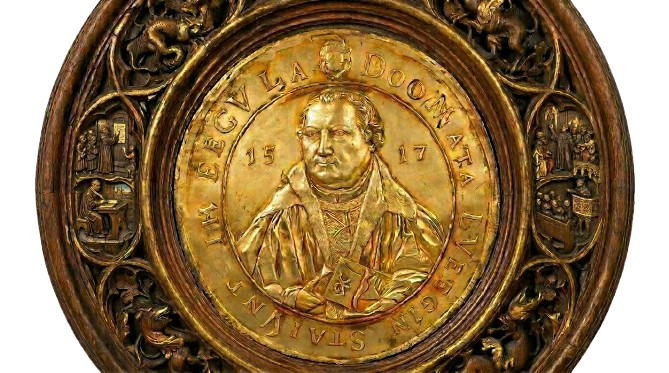

the 1661 Eisleben "Luther-taler"
a silver medal commemorating the 100-year anniversary of an unresolved debate about the Augsburg Confession
Imagine holding a heavy silver disc in your hand. It is worn smooth in places where someone’s thumb rubbed it again and again, maybe during a dangerous journey, maybe while listening to a sermon about standing firm in the faith. That disc is the 1661 “Luther-taler”, one of the most fascinating Reformation medals ever made.

what is this “Luther-taler”?
The Luther-taler is a large silver medal made in the town of Eisleben in 1661, about 100 years after an important church gathering called the Naumburg Convention. It looks like a big silver coin, but it was never normal money you could spend in a market; instead, it was a commemorative piece meant to remember a struggle inside early Lutheranism about what they believed and how they would confess it to the world.
numismatic terms used to describe this piece
- Taler: A large silver coin used in many German lands; our word “dollar” comes from “Taler.” The Luther-taler only looks like a Taler; its weights are all wrong for real money.
- Medal: A stamped piece of metal, like a coin, but not made to buy things; it commemorates a person, event, or idea.
- Obverse: The “front” of a coin or medal, usually with the main portrait or main image.
- Reverse: The “back” side, often with a city view, coat-of-arms, or motto.
- Planchet: The blank metal disc before it is struck with the dies.
- Die: The engraved metal stamp that presses the design into the planchet.
- Legends: The words engraved around the edges of the design.
Once you know these words, the medal starts to feel less like a mysterious object and more like a story written in metal.
not really a coin — a "taler-like" medal
At first glance, collectors called this piece the Luther-taler and even a “Taler,” as Christian Junker did in 1706. But when numismatists weighed many examples, they found them at 58 g, 43 g, 24 g, 21 g, 19 g, 17 g, and 14 g—everything except the standard Taler weight of about 29 g, which shows it was never a regular coin.
On top of that, the mint-master in Eisleben at the time, Hans Philipp Koburger, normally used his initials “HPK” as a mint-mark on real currency, but that mark is missing on this piece, another clue that this is a commemorative medal and not everyday money. So, the “Luther-taler” is best understood as a medal in the style of a Taler—made to look like important money but actually meant to carry a message.
a numismatic piece that doesn’t measure up
If you flip most modern coins over, the front and back are lined up in a regular way: turn the coin top-to-bottom and the other side is upright. On the Luther-taler, the obverse and reverse dies were positioned independently, so pieces show a random orientation between front and back.
For a junior high sleuth, that’s a clue: this wasn’t mass-produced with the precision of a busy money mint; it was a special project where the message mattered more than machine-like regularity.
cloverleaf, swan — and other secret symbols
On some examples of the medal, at the beginning of the legends, you can spot tiny pictures:
learn more
- A three-leaf clover with a stem (a tri-foil), and
- On another design type, a water foul—described by different scholars as a duck, goose, or swan.
Some people thought these were engraver’s marks, tiny symbols showing which artist cut the dies. But no clear evidence has been found of engravers in that region using a cloverleaf or swan as their personal sign, while there is a long tradition of connecting a swan with Martin Luther.
The cloverleaf may point to the Trinity, a key Christian teaching, and the small floral “floret” seen on one reverse may recall the Luther-rose, Luther’s famous personal symbol. So here the medal is whispering in symbols: “This is about Luther’s faith, the Trinity, and the Reformation,” even while the official event it commemorates was a heated debate about strictly following the confession of Martin Luther or following the compromised theological confession of Philipp Melanchthon.


the drama behind the date: Naumburg 1561
The date “1661” in a cartouche on the front looks back 100 years to the Naumburg Convention of 1561. This was a meeting of Lutheran princes and leaders who were trying to decide how to stand together when the Roman Catholic Church called them to attend the Council of Trent.
learn more
Here’s the tension:
- Many stood firmly by the original Augsburg Confession of 1530, the key Lutheran confession of faith.
- Others, influenced by Philipp Melanchthon and more sympathetic to Calvinist ideas, wanted to use Melanchthon’s revised (altered) Augsburg Confession of 1540 as the basis for unity.
Elector Frederick, with the support of Elector August, demanded that the 1540 edition be recognized as the correct explanation of the original Augustana, and many agreed. But Duke John Frederick’s theologians warned him they would resign if he signed such a document; he answered that he would rather mount his horse and ride away than sign a text that did not clearly reject the errors they opposed.
The convention ended on February 8, 1561, without a unified confession: no neat signature page, just a broken attempt at unity. When you hold the Luther-taler, you hold a memory of that unresolved struggle over what it meant to be truly “Lutheran.”
two different portraits of Martin Luther
On the obverse of the medal, Martin Luther is shown almost facing you, slightly turned to the right, dressed in his preaching or academic robe, with a closed Bible in his hand. But there are actually two design types, as if two artists told the same story in different styles.
learn more
First design type:
- Luther has almond-shaped eyes, a furrowed brow, and a strongly marked line between nose and upper lip (the philtrum).
- His robe has a rough, fur-like collar, and the Bible he holds is large and clearly visible—this is Luther the preacher with the Word of God firmly in hand.
Second design type:
- His head tilts slightly, eyes are more round, and his hair and robe are more finely detailed.
- The shirt beneath his robe shows nine little buttons and buttonholes, and the collar is smoother, less rough.
- The Bible is much less prominent or may even vanish into the folds.
The legends around him read: “MARTIN LUTHER DER HEILIGEN SCHRIFFT DOCTOR WEILAND PRED[IGER UND PROFESSOR ZU WITTENB[ERG” – “Martin Luther, Doctor of Holy Scripture, formerly preacher and professor at Wittenberg.” This is Luther remembered as a learned Bible teacher and preacher, not just a rebel nailing papers to doors.
A city under a twin-spired church
- Flip to the reverse, and you see a cityscape that scholars connect with engravings of Eisleben, especially a view published in 1616 in Petrus Bertius’s “Commentariorum rerum Germanicarum.”
- The most striking feature is the twin-spired St. Andreaskirche, rising over the town.
- An elevated windmill stands on a hill outside the city, and rows of trees are carefully arranged.
In the sky, three birds fly above the town, tying the earth below to the heavens above.
The legends on the reverse declare: “GOTTES WORT UND LUTHERS LEHR VERGEHT NUN UND NIMMERMEHR – ISLEBIE EISLEBEN” – “God’s Word and Luther’s teaching will never and never more pass away – Eisleben.” The city itself becomes a kind of sermon: this is the place tied to Luther’s life and death, where God’s Word and Luther’s teaching are imagined as permanent, even though human princes and conventions argue and fail.
Coats-of-arms and laurel wreaths
Beneath the city floats a crowned coat-of-arms of the House of Mansfeld, divided into four sections.
- The 1st and 4th fields show the diamonds and stripes of Mansfeld.
- The 2nd field displays the eagle of Arnstein.
- The 3rd field has the lion of Heldrungen.
Around the edge there is a border of laurel leaves, like a wreath given to a victor, but on many surviving pieces this border is partly off the flan because the planchets were a bit smaller (about 44.5–45.5 mm) than the dies were engraved for (about 46.5 mm). The second design type uses smaller laurel leaves that can look thorn-like or saw-toothed when worn, adding a sense of sharpness to the edge.
Here, politics and faith wrap around each other: noble houses, victory wreaths, and a city full of churches and mills form a frame for the motto about God’s Word and Luther’s teaching.
a numismatic piece often worn
The Luthertaler became one of the most popular Reformation medals, so popular that many owners turned it into jewelry.
The Luthertaler became one of the most popular Reformation medals, so popular that many owners turned it into jewelry.
learn more
- People added loops or holders to wear it as a necklace, especially with Luther’s portrait facing out.
- Later, some tried to “erase the jewelry past” by removing the loops and filling the holes with silver, so you sometimes find pieces with repaired edges.
- Because they were worn and handled so much, many surviving examples show heavy wear, especially on Luther’s face and robe.
Collectors today sometimes find medals that have been re-tooled—meaning someone re-engraved Luther’s eyes, robe folds, or other details to make the worn design appear fresh again, and a few were even chased (reworked with small tools on the surface). There are also later casts in silver and bronze made from original 1661 pieces.
For a student, this means: this medal didn’t just sit locked in a cabinet; it traveled, was handled, and was loved enough to be worn down and restored again.
How rare is it really?
Because it was so popular, the Luthertaler is not incredibly rare as an object; many examples exist. But high-quality examples are another story:
- It is unusual to find one in near-pristine condition.
- It is uncommon to see a piece with the laurel wreath border fully visible.
- Heavier weights like 58 g or 43 g are much harder to find.
So a young collector might actually see one in a museum or catalog, but seeing a really sharp, unworn, heavy example is like spotting a rare bird.

memorializing the Reformation in metal and art
The Luthertaler shows how Reformation history is not only in books and sermons but also in coins, medals, and fine art.
learn more
- Portraits of Luther by artists like Lucas Cranach the Elder influenced the way he is shown on medals.
- City views, coats-of-arms, and mottos connect theology to real places and real rulers.
- The legends, tiny symbols like swans, cloverleaves, and Luther-rose, and even the choice not to use the mintmaster’s mark tell us what story the makers wanted to tell.
This one medal lets you explore questions such as:
- What did people think “true Lutheran teaching” was 100 years after Luther?
- Why did some Lutherans lean toward Calvinist ideas, and why did others resist?
- How did believers use medals and necklaces as reminders of faith and identity?
If you follow those questions, you will end up reading the Augsburg Confession, studying prints of the Naumburg Convention, comparing portraits of Luther, and flipping through catalogs of Reformation coins and medals, just like professional historians and numismatists do today.
Your next steps as a "numismatic sleuth" and “history detective”
Here are some ways a junior high student could dig deeper into this centuries-old treasure:
- Sketch the obverse and reverse of the Luther-taler and label every symbol you can identify: church, windmill, birds, coat-of-arms, laurel wreath, Luther’s Bible, and any tiny cloverleaf or swan.
- Choose one element—like the St. Andreaskirche, the House of Mansfeld, or the motto “Gottes Wort und Luthers Lehr vergeht nun und nimmermehr”—and research its story.
- Compare the medal’s Luther portrait to a painted Luther by Cranach: What details match, and what has changed?
- Imagine you live in 1661 and write a short diary entry about why you bought this medal and why you wear it.
By doing that, you are not just learning about a piece of metal; you are learning to read history in silver, discovering how faith, politics, art, and money all tell the story of Martin Luther and the Reformation.